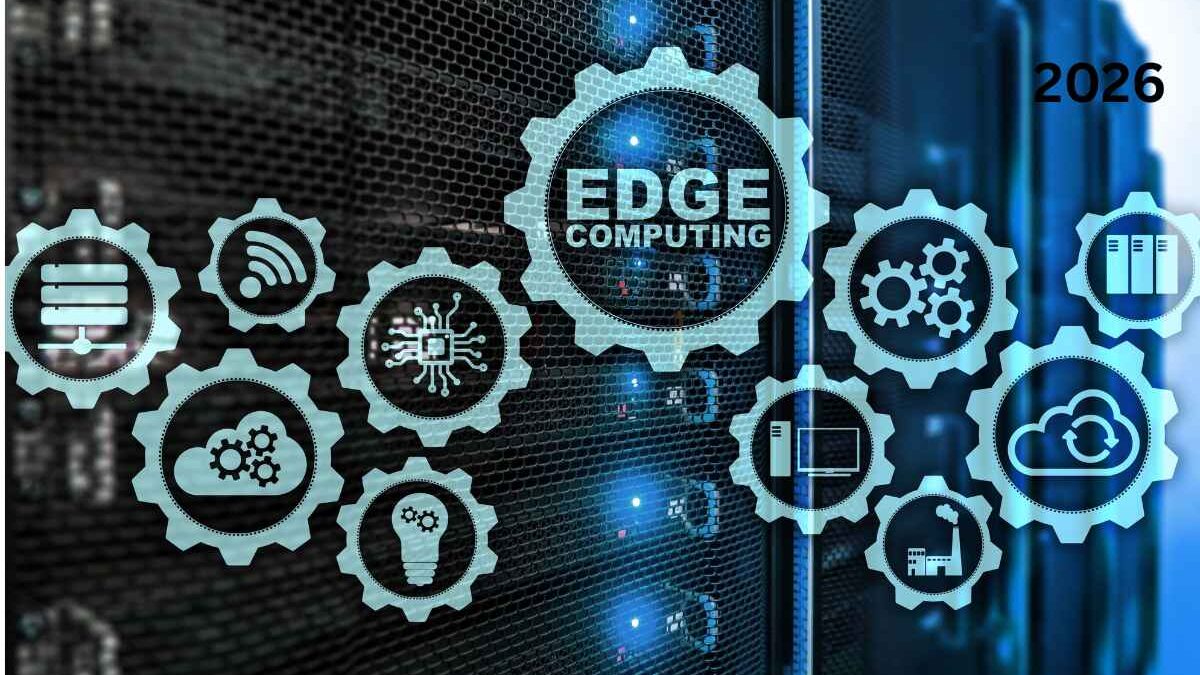
Edge computing and cloud computing are often presented as competing technologies, but that framing is misleading. The cloud remains a foundation for scalable storage, analytics, application hosting, and centralized management. Edge computing extends selected processing closer to the people, machines, sensors, and locations where data is created or consumed.
The right architecture is usually not “edge or cloud.” It is a decision about which work should happen locally, which work should happen centrally, and how data should move between those layers.
What is cloud computing?
Cloud computing provides computing resources such as servers, storage, databases, networking, and software through a service provider’s infrastructure. Organizations can provision resources on demand rather than buying and maintaining all physical infrastructure themselves.
Cloud platforms are well suited to centralized applications, large data stores, elastic workloads, global services, backups, analytics, collaboration systems, and workloads that benefit from managed services.
What is edge computing?
Edge computing runs workloads closer to the endpoint where data is generated or used. The edge could be a factory gateway, retail location, telecommunications site, vehicle, industrial computer, local server, or infrastructure positioned near end users.
Moving selected processing closer to the source can reduce latency, reduce the volume of data sent over wide-area networks, and allow some operations to continue when cloud connectivity is limited.
Edge computing vs cloud computing at a glance
| Factor | Edge | Cloud |
|---|---|---|
| Processing location | Near devices or users | Provider data centers |
| Latency | Can be very low | Depends on network distance |
| Connectivity | Can support local operation | Usually depends on reliable network access |
| Management | Distributed fleet | More centralized |
| Physical maintenance | May involve many sites | Provider manages data-center hardware |
| Data aggregation | Filters or processes locally | Excellent for centralized analytics |
Why latency matters
Latency is the delay between an action and a response. For email or a business dashboard, a small delay may not matter. For industrial control, robotics, real-time video analytics, interactive gaming, or some augmented-reality experiences, delay can become a functional problem.
Edge processing can make decisions close to the device and send summaries or selected data to the cloud later. This avoids a long network round trip for every event.
Connectivity and offline operation
A cloud-only design assumes the network path is available when the application needs it. That is reasonable for many office systems but less reliable in factories, remote sites, ships, mines, vehicles, and locations with unstable connections.
An edge system can continue performing critical local functions and synchronize with the cloud when connectivity returns. Designers still need to decide how to handle delayed updates, conflicts, and data consistency.
Data volume and bandwidth
Connected cameras, industrial sensors, and machines can generate more raw data than a business wants to transmit continuously. Processing at the edge can filter, compress, summarize, or classify data before sending the most useful information upstream.
That can reduce bandwidth and storage costs, but it also creates a distributed software-management challenge. The organization must keep edge devices patched, monitored, consistent, and securely configured.
Security differences
Cloud platforms benefit from centralized controls, mature identity systems, automated logging, and provider-operated physical infrastructure. Edge environments may place computing devices in stores, factories, vehicles, or other locations where physical access is easier.
At the same time, edge processing can reduce the amount of sensitive raw data leaving a site. Security therefore depends on architecture. Edge devices need protected management interfaces, patching, encrypted storage, strong identity controls, and a plan for lost or tampered hardware.
Scalability
Cloud services are attractive because capacity can often be increased without deploying hardware to every location. Edge computing scales differently. Adding 500 locations may mean managing hundreds of physical edge nodes, each with software, networking, monitoring, credentials, and lifecycle requirements.
This is why centralized fleet management is important for serious edge deployments. Teams should be able to deploy software, rotate certificates, collect logs, measure health, and recover devices without visiting every site.
Cost: which approach is cheaper?
There is no universal answer. Cloud costs may include compute, storage, managed services, and data transfer. Edge costs may include hardware, local maintenance, replacement, support, remote management, and energy. A design that moves everything to the edge can be expensive, while a design that streams every raw event to the cloud can create high network and storage bills.
A useful cost model separates real-time local processing from long-term centralized storage and analysis.
Best use cases for edge computing
- Industrial control and manufacturing systems.
- Computer vision near cameras.
- Retail systems requiring local responsiveness.
- Connected vehicles and transportation.
- Remote locations with limited connectivity.
- IoT data filtering and local analytics.
- Applications that require very low latency.
Best use cases for cloud computing
- Business applications and collaboration.
- Centralized data warehouses and analytics.
- Backup and disaster recovery.
- Web and mobile application hosting.
- Machine-learning training.
- Large-scale storage.
- Globally distributed services.
Why hybrid edge-cloud architecture is common
Consider a smart factory. Cameras and sensors may produce continuous data. The edge system can detect immediate anomalies and control local equipment. The cloud can aggregate information from multiple factories, train models, store long-term history, and provide management dashboards. Updated models can then be deployed back to the edge.
This split uses each environment for what it does best instead of forcing one architecture onto every part of the workload.
Questions to ask before choosing an architecture
- How quickly must the application respond?
- What happens if internet connectivity is interrupted?
- How much data is generated per hour or per day?
- Can raw data leave the location?
- How many edge locations need lifecycle management?
- Which data needs long-term centralized analysis?
- What are the physical and cybersecurity risks?
- How will software updates and certificates be managed?
- What is the total cost across hardware, cloud, bandwidth, and operations?
Frequently asked questions
Does edge computing replace the cloud?
No. Edge computing usually complements the cloud. Local systems handle latency-sensitive or connectivity-sensitive work, while the cloud provides centralized storage, analytics, services, and management.
Is a CDN edge computing?
A content delivery network is an edge technology because it places content and sometimes computing closer to users. Modern edge platforms can also run application logic at distributed points of presence.
Is edge computing only for IoT?
No. IoT is a major use case, but edge computing is also used for web delivery, telecommunications, retail, media, industrial workloads, and local AI inference.
Which is more secure?
Neither is automatically more secure. Cloud and edge environments have different risks. Security depends on identity, configuration, patching, encryption, monitoring, and architecture.
Sources and further reading